High-Performance Tennis Coaching.

Private, squad and high-performance coaching across Sydney's premium courts — designed for players who want skill that transfers under pressure.

Coaching & Programs

Our Team

Nick O'Sullivan

Founder & Head CoachFounder // NickTheCoach.com

Over 15 years of court experience. Dedicated to a philosophy of mutual enjoyment, detailed tactical breakdown, and straightforward environment-based problem solving.

David Miklas

Performance CoachGermany & Czechia // BTV C-Coach License

Competed for several years in the German (Bavarian) and Czech national leagues. High-intensity coaching style utilising differential learning to naturally correct footwork. Fluent in German, English, Slovak and Czech.

Théo Hélie

Performance CoachInternational Coach // FFT & ITF Certified

Extensive competitive history in national and international tournaments. Coached across France, Mexico and Australia with a heavy focus on variable training environments. Winner of an ITF J60 tournament as a coach. Fluent in French and English.

Branko Jaric

Plyometrics Performance PartnerAplyoselfJump & Power Development // Landing Mechanics // Reactive Agility

Independent plyometrics and jump specialist working with Primal Active athletes to develop explosive power, controlled landing mechanics, and reactive on-court movement. Branko designs progressions that transfer directly to tennis acceleration and change-of-direction.

Instagram

Interested in Coaching With Us?

We are always looking for coaches with verifiable credentials and a high-performance, athlete-centred methodology. Applications include your coaching credentials.

Apply to join our team
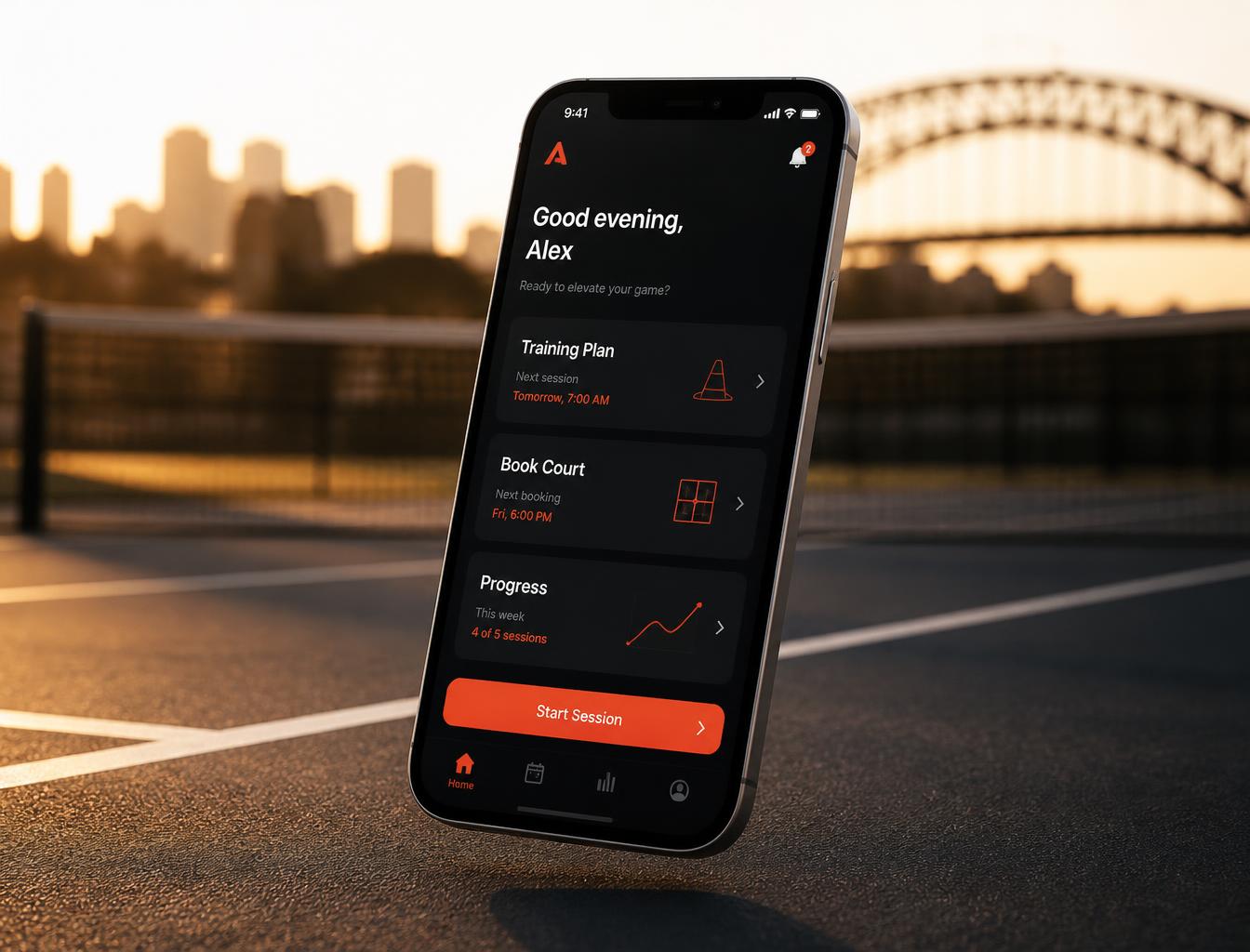
Primal Active Portal app on a phone at a Sydney tennis court

Primal Active
Portal

The app that keeps your training, bookings and progress in one place. Built for athletes who train with intent and a team that plans with precision.

Training Plans

See the drills and sessions your coach has assigned, with video and rep targets.

Court Booking

Reserve your slot across Bondi, Vaucluse, Centennial Park and North Sydney.

Progress Tracking

Log skills, notes and session completion so your coach can refine the plan.

Coach Messaging

Stay aligned with feedback, cancellations and schedule updates in one place.

Branko Jaric x Aplyoself

The Plyometrics
Programme

A dedicated jump, landing and reactive strength programme built for tennis athletes, created by Branko Jaric of Aplyoself exclusively for the Primal Active Performance Portal.

It is the first release in our expert series: specialist programmes from invited authorities in strength, movement and recovery, delivered inside the same app your coach uses to plan your week.

  • Progressive blocks from landing mechanics to reactive power
  • Video demonstrations with rep, contact and rest targets
  • Assignable by your coach alongside on-court sessions
  • Tracked in the portal so progress carries into your plan
Get early access

Our Premium Locations

Court Conditions

Five-day Sydney forecast so you can plan sessions around the weather. Wet-weather sessions move indoors or reschedule automatically.

Sydney courts
13°Mostly sunny
1 km/h
Sat16°8° · 78%
Sun18°7° · 4%
Mon21°8° · 29%
Tue16°7° · 4%
Wed16°7° · 0%

Resources & Player Insights

Sebastian Lavorato: Australia's Latest Tennis Talent on the Rise

Young Australian Sebastian Lavorato is making waves in the junior tennis circuit, showcasing remarkable talent and dedication. His recent successes highlight the depth of emerging talent in Australian tennis.

Read Article —

Unpacking Tennis's Distinct Charm: A Look at its Unique Attributes

A recent article from Australian Tennis News delves into what makes tennis stand out from other sports, highlighting its unique blend of physical and mental challenges.

Read Article —

Why Racquet Sports Are Good for Neuroplasticity

Tennis, squash, badminton and table tennis demand rapid prediction, timing and spatial mapping. These demands are exactly what keeps the brain adapting across a lifetime.

Read Article —

Barefoot Training for Tennis Players

The foot has 26 bones, 33 joints and more than a hundred muscles and tendons. Training it without a shoe on, carefully and progressively, is one of the cheapest performance additions available.

Read Article —

Coach the Ball, Not the Swing

Skill-acquisition researcher and Major League baseball consultant Rob Gray has spent two decades testing where hitters put their attention. The finding transfers straight to a tennis court.

Read Article —

Repetition Without Repetition

Baseball consultant Rob Gray's practice research keeps landing on the same result: the messier session usually produces the better competitor. Here is how we use that on court.

Read Article —

Practice That Looks Like the Match

Ball machines and basket feeds strip out the information players actually read. Rob Gray's research on baseball batting and simulated training explains why, and what to keep.

Read Article —

A Short History of Tennis

From monastery courtyards to Grand Slams — how a handball game played against a wall became the sport we coach today.

Read Article —

Gross Motor and Fine Motor Development in Preschoolers

Why climbing, pulling, running and ball play matter for toddlers and preschoolers — and how one Primal Active coach is building movement habits from five months old.

Read Article —

When Can My Child Start Tennis?

Most traditional programs suggest waiting until age five or six. We look at movement mapping, balance exploration, and tracking variables from a completely different timeline.

Read Article —

The Different Types of Tennis Racquet

Power, tweener, control and junior frames — the four families of racquet, who each one is built for, and the trade-offs you accept with each.

Read Article —

The Death of the Perfect Stroke

Why modern sport science is leaving robotic drilling behind. Practising variations builds players who survive match pressure instead of breaking.

Read Article —

The Anatomy of a Tennis Racquet

Head, throat, shaft, butt cap, grommets and beam — the parts of a frame and what each one does to the ball.

Read Article —

Stop Thinking About Your Elbow

Internal coaching cues degrade fluid athletic performance. Changing your focus to the environment can instantly clean up your mechanics.

Read Article —

Red, Orange, Green: Tennis Balls Explained

Why juniors start on slower balls, what each colour actually does, and how to know when a player is ready to move up a stage.

Read Article —

The Science of Serve Velocity: Where Power Actually Comes From

Kinetic chain research shows more than half of serve speed is generated below the shoulder. Here is what that means for your training week.

Read Article —

The Case for Court Sprints

Tennis is a series of discrete, explosive actions. Steady-state jogging fails to prepare you for true competitive court demands.

Read Article —

How to Choose a Tennis Racquet

Head size, weight, balance, stiffness and grip — what actually changes when you change frames, and how to pick one that suits the player you are now.

Read Article —

Elastic Power & Plyometrics

Mastering the kinetic chain means using the stretch-shortening cycle. Strategic jumps and reaction bounds transfer directly to explosive court coverage.

Read Article —

Why Tennis Players Belong in the Pool

High-impact changes of direction tax joints heavily. Zero-impact swimming flushes metabolic waste and balances rotational muscle systems.

Read Article —

Media Release: Primal Active Opens 2026 Collegiate Pathway Intake

Primal Active has opened applications for its 2026 Collegiate Pathways intake, supporting Australian and international juniors into US college tennis programs.

Read Article —

Strategic Remedial Massage

Repetitive asymmetrical loading alters biomechanics. Soft-tissue restoration maintains crucial joint capsule mobility.

Read Article —

The Four Essential Ground Actions

Before you swing, you have to find position. An ecological breakdown of the split-step, unit turn, open stance and recovery cross-step.

Read Article —

Load Management: Why Sudden Training Spikes Cause Most Tennis Injuries

The acute:chronic workload ratio predicts injury risk better than total hours on court. A practical framework for players and parents.

Read Article —

Heat, Hydration and the Australian Summer Match

Fluid losses of just 2% body mass measurably reduce reaction time and stroke accuracy. A Bondi-specific hydration protocol.

Read Article —

Podcast Ep. 1 — Building a Coaching Business in Sydney

Nicholas O'Sullivan on starting Primal Active, coaching philosophy, and what juniors get wrong.

Read Article —

Media Release: Primal Active Launches On-Court Performance Lab

A new testing and monitoring service brings serve velocity, movement and load tracking to every Primal Active member.

Read Article —

Media Release: Primal Active Launches Junior Development Program

Sydney-based Primal Active, led by Nicholas O'Sullivan, launches a structured pathway for junior players aged 8–16.

Read Article —

Deliberate Practice vs Hitting: Why Two Hours Can Beat Six

Blocked repetition feels productive and transfers poorly. Randomised, variable practice looks worse in training and wins matches.

Read Article —

Court Etiquette Every Player Should Know

The unwritten rules that keep social tennis fun — from calls to changeovers.

Read Article —

Tennis Basics: The Six Core Strokes

Forehand, backhand, serve, return, volley, overhead — the six shots every player needs.

Read Article —

Tennis Basics: Grips

Continental, eastern, semi-western, western — what each grip does and when to use it.

Read Article —

Court Layout & Lines

Baseline, service box, alley, T — every line on the court and what it is for.

Read Article —

Scoring Explained: Games, Sets, Tiebreaks

Why the score jumps from 15 to 30 to 40, what deuce means, and how tiebreaks actually work.

Read Article —

The Rules of Tennis: A Complete Overview

Everything you need to know about the modern rules of tennis, from serving order to let cords.

Read Article —

Tennis and Sarcopenia: The Racquet as Muscle Insurance

Adults lose 3-8% of muscle mass per decade after 30, and the decline accelerates after 60. Tennis is one of the few sports that loads muscle, bone and the nervous system hard enough to slow it — and keeps people coming back for decades.

Read Article —
View all resources

Latest reels

Sessions, drills and behind the scenes from the Bondi courts.

Follow @primalactivesydney

Find Your Program

Prefer to talk it through first?
Book a 30-minute discovery call.

Step 1 of 9 // Name

Welcome to Primal Active. What is your full name?